Serpnix Team
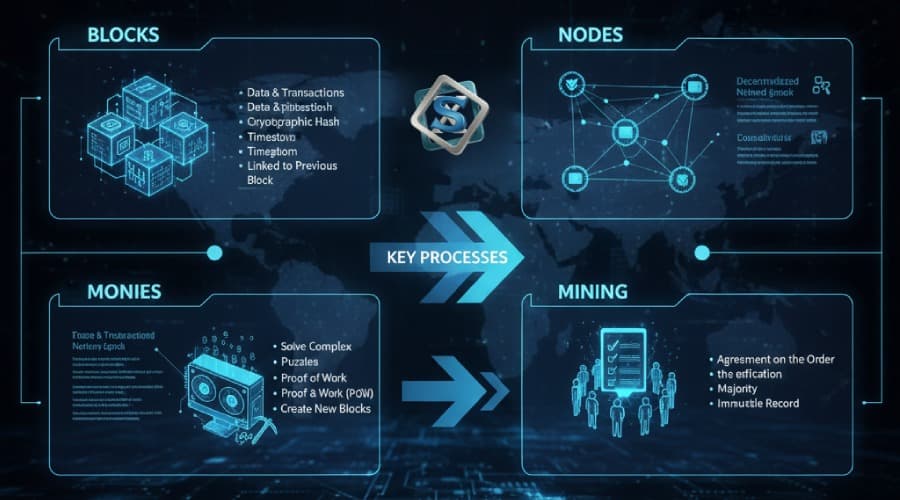
How Blockchain Works: Blocks, Nodes, Mining & Consensus Explained
Blockchain technology has revolutionized industries from finance to supply chain management, offering a decentralized way to record transactions securely. But how does it all work behind the scenes? At its core, blockchain is a distributed ledger that ensures transparency, immutability, and trust without needing a central authority. This article breaks down the fundamental components blocks, nodes, mining, and consensus explaining how they interact to make blockchain a robust system. Whether you're a beginner curious about cryptocurrencies like Bitcoin or a professional exploring enterprise applications, understanding these elements is key to grasping blockchain's potential.
What is Blockchain? A Quick Overview
The magic happens through four main components: blocks, nodes, mining, and consensus mechanisms. These work together to validate and record data securely. Let's explore each one step by step.
Understanding Blocks: The Building Units of Blockchain
- •Header: Contains metadata like the previous block's hash (linking blocks in a chain), a nonce (a number used in mining), and a timestamp.
- •Body: The actual data, such as transaction details (e.g., sender, receiver, amount).
- •Merkle Tree: A data structure that summarizes all transactions in the block for efficient verification.
Nodes: The Network's Backbone
- •Full Nodes: Store the complete blockchain history and enforce rules. They verify transactions and blocks independently.
- •Light Nodes: Store only essential data, like headers, and rely on full nodes for details. They're used in mobile wallets for efficiency.
- •Mining Nodes: Special nodes that compete to create new blocks (more on this later).
Mining: The Process of Creating New Blocks
How Mining Works:
- •Miners collect pending transactions into a candidate block.
- •They repeatedly change the nonce and hash the block until they find a valid hash (proof-of-work).
- •The first miner to solve it broadcasts the block to the network.
- •Other nodes verify the solution and add the block if it's correct.
Consensus Mechanisms: Ensuring Agreement Across the Network
- •Proof-of-Work (PoW): Used by Bitcoin, it relies on computational power. Miners compete, and the majority's decision prevails. It's secure but energy-intensive.
- •Proof-of-Stake (PoS): Validators are chosen based on their stake (coins held). Ethereum's shift to PoS reduces energy use while maintaining security.
- •Other variants include Delegated Proof-of-Stake (DPoS), Proof-of-Authority (PoA), and more.
Other Mechanisms:
Delegated Proof-of-Stake (DPoS)
Stakeholders vote for delegates to validate blocks, as in EOS.
Proof-of-Authority (PoA)
Trusted validators confirm blocks, suitable for private blockchains.
Byzantine Fault Tolerance (BFT)
Ensures agreement even if some nodes fail or act maliciously, used in Hyperledger.
Consensus algorithms like these make blockchain fault-tolerant. For instance, in PoS, a validator with more stake has a higher chance of being selected, aligning incentives with network health.
How These Components Interact: A Step-by-Step Example
- •Transaction Initiation: Alice sends 1 BTC to Bob. The transaction is broadcast to nodes.
- •Validation by Nodes: Full nodes check if Alice has the funds and the transaction is valid.
- •Mining: Miners bundle the transaction into a block and compete to solve the PoW puzzle.
- •Consensus: Once a miner finds the solution, nodes verify it. If approved, the block is added, and the transaction is confirmed.
- •Chain Update: All nodes update their copies, and the process repeats.
This cycle ensures security and decentralization. If a hacker tries to alter a past block, they'd need to redo the work for that block and all subsequent ones, which is practically impossible.
Challenges and Innovations in Blockchain
While powerful, blockchain faces issues like scalability (slow transaction speeds) and energy consumption. Innovations address these:
Layer 2 Solutions
Like Lightning Network for faster Bitcoin transactions.
Energy-Efficient Consensus
PoS and hybrids reduce carbon footprints.
Interoperability
Protocols allowing different blockchains to communicate.
As blockchain evolves, understanding blocks, nodes, mining, and consensus will help you navigate its applications, from DeFi to supply chains.